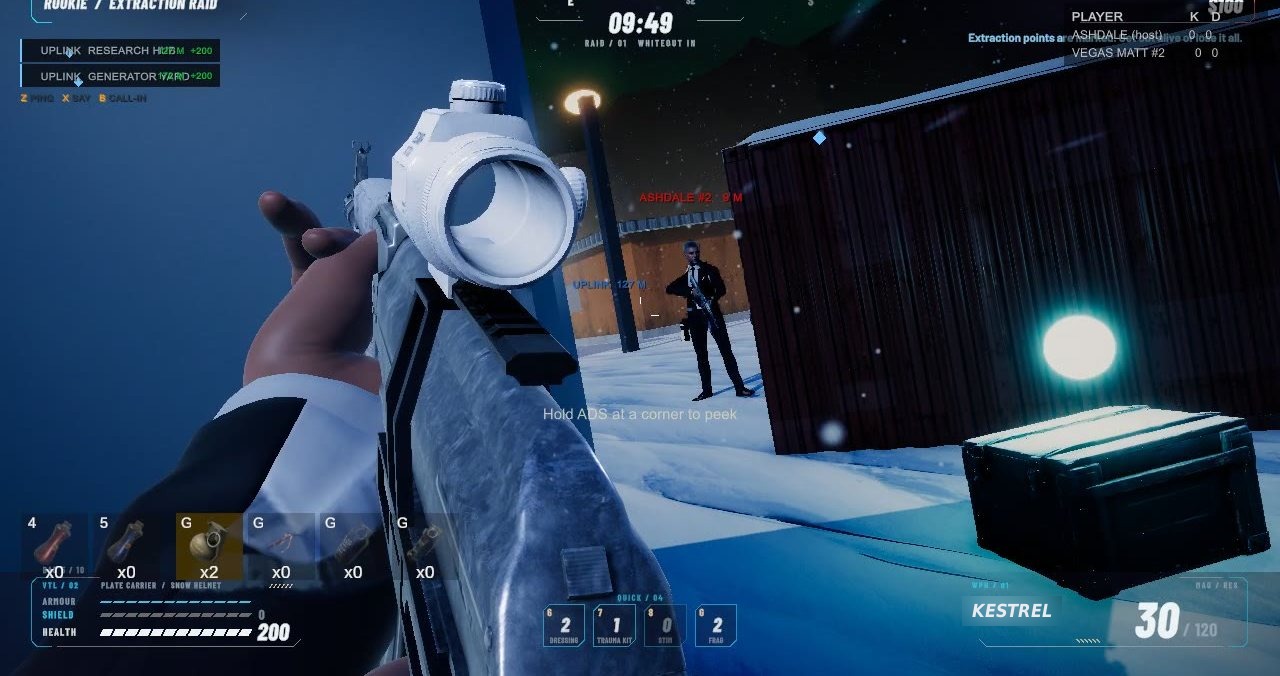
Competitive integrity briefing · November 2026
Built for
real stakes.
How Real Money Multiplayer keeps every money match fair, from the network wire to the wallet. The server decides. Every match is signed. Every flag waits for a person before money moves.
Press → or swipe · G index · F fullscreen · M reduce motion
01 — The problem
In a money match, the client is in the cheater's hands.
Every PC is hostile territory. Its memory can be read, its packets forged, its build modified, its inputs automated. A game that trusts the client pays out on a lie.
One design rule
Never let a client decide anything that moves money.
Attacker model: six types, in order of effort, from the Real Money Multiplayer competitive-integrity threat model.
02 — The answer
The server decides everything that moves money.
One author
A dedicated server that no player can host, take over or inherit.
Intent, not results
Clients send inputs and shot facts. The server computes every outcome.
Recompute, don't trust
Hits, ammo, loot and money are re-derived from the server's own state.
Money reads the record
Settlement uses nothing but the signed match log.
Every match replayable
Committed seeds and logged inputs let anyone holding the log re-check it.
Trust no single party
Signing roots live in a key-management service. Third parties can verify.
03 — Defence in depth
Six layers. Each holds if another fails.
Follow one packet from the wire to the wallet. At every layer, something independent checks it, and every decision lands in a signed record.
Transport Tachyon
Encrypted sessions · issuer-signed passes · single-use host claims
Authority Dedicated server
Server-decided hits · movement referee · fog of war · sealed randomness
Client Hardened release
Native-compiled build · build & device attestation · no detectors shipped
Behaviour Aim analysis
Seven detectors · stream-gap rule · re-scan of every past match
Money Escrow & ledger
Settlement from the signed log · review holds · two-reviewer rule
Evidence The signed record
Hash chain · KMS-rooted keys · transparency log · verified replays
L1 — Transport · Tachyon
Every packet is sealed, counted and bound to its session.
- Encrypted by default, no off switch. Every session runs an X25519 key exchange, then seals each datagram with ChaCha20-Poly1305.
- Nothing to read on the wire: no names, no remote calls, no session token.
- Replay-proof. A per-direction counter moves only after the authentication tag verifies, so forged packets can't advance it.
- Relay identity is pinned. A fake relay is refused.
- Flood-resistant. Address cookies and per-peer budgets stop spoofed or abusive traffic early.
Tachyon protocol 8 specification and test reports. The cipher suite uses public standards (RFC 7748, 8439, 5869); an independent cryptographic review is on the roadmap.
L1 — Admission · Tachyon
No signed pass, no seat at the table.
The backend signs every pass to a money room. The relay checks it against a pinned public key and holds no secret that could mint one, so seizing the relay host mints nothing.
- Single-use host claims. A host pass burns on first use, so a leaked one can't re-host the room.
- One pass, one session. A second login is refused and recorded in the signed log.
- If the server dies, nobody inherits. The room closes, the match voids, stakes are refunded.
- Money only on the token relay. The backend refuses to settle a match from anywhere else.
L2 — Authority
Staked matches run on our servers.
A headless server built from the game's own code holds all authority. No local player, no graphics, and no one who can host it, take it over or inherit it.
L2 — Server-decided hits
The client says where it aimed. The server decides what it hit.
- Rewind. Each shot is judged where the shooter saw the target, within a hard cap and a ping the server measures itself. Latency can't be bought.
- The server's own ray is cast from the server's copy of the shooter and tested against its own walls.
- Damage from the weapon table, never from a client number. The server owns magazines, reloads and fire rate.
- Melee and grenades too: the server judges every swing and flies its own replica of every throw.
L2 — Movement & recoil referees
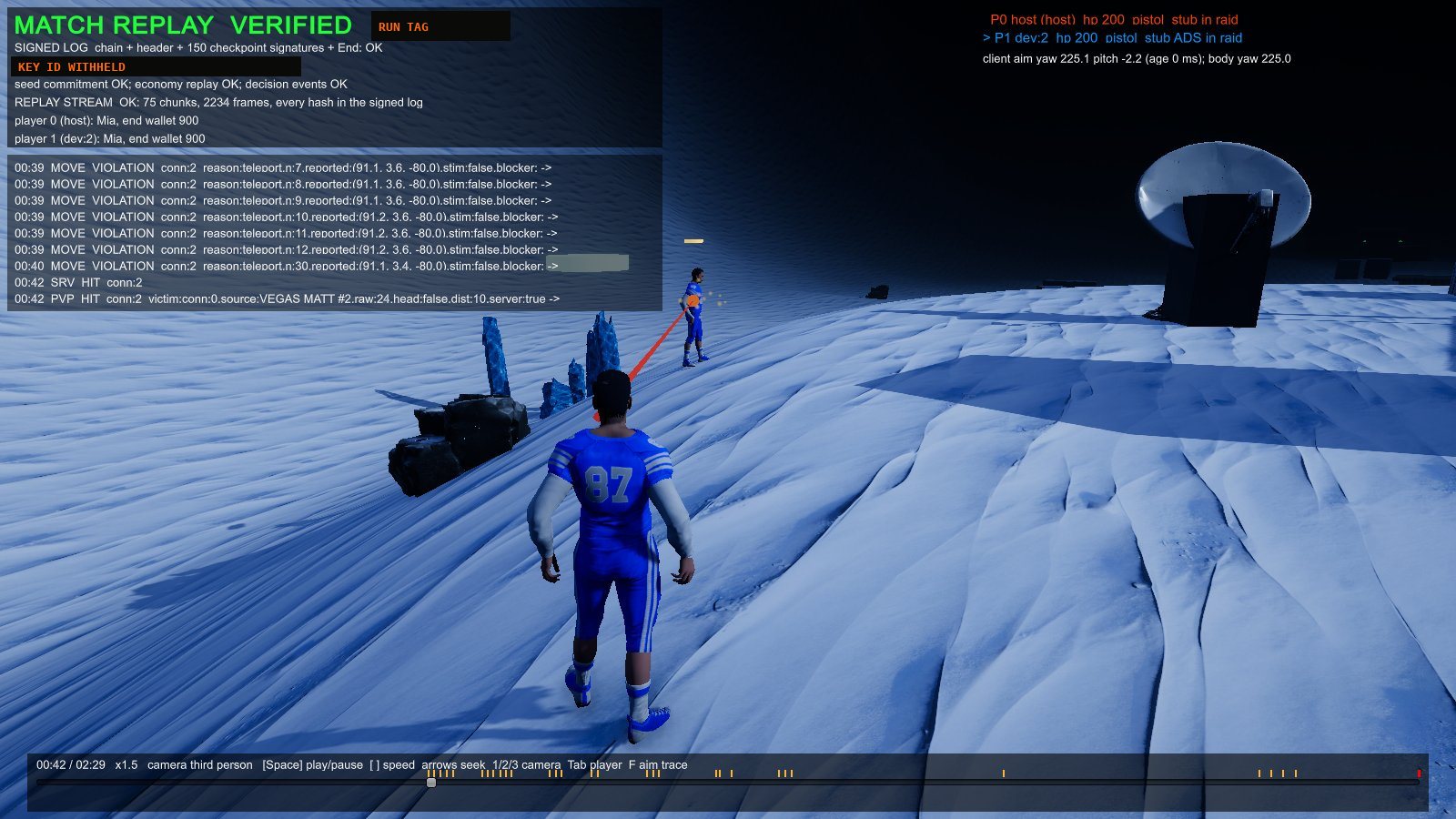
Every move and every spray is refereed.
L2 — Fog of war
A wallhack can't show what was never sent.
- The server checks sight lines in its own physics world, for every player and every target.
- Hidden enemies aren't in the message at all. Memory-reading tools have nothing to read.
- A hidden shooter reaches you only as a direction cue, never a position.
- Crate contents go only to the player searching it. Nobody on the deploy screen sees a live enemy.
- You can't hit what you weren't shown. Such hit claims are refused.
L2 — Tactical poses as server state
Lean, cant, mount: the server owns your pose.
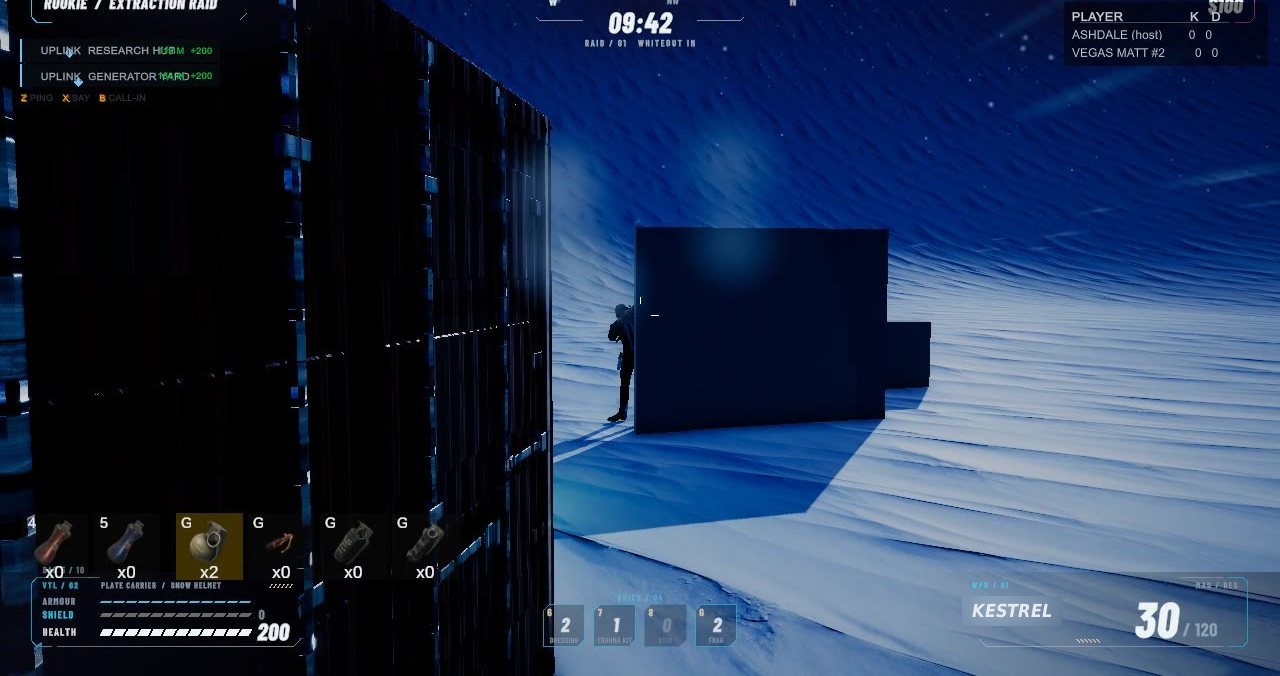
- Every pose is a claim. Anything that changes what you can see, or what can hit you, is bounded, rate-limited, logged and replayed by the server.
- The head is swept against the server's walls, so no lean puts it through cover.
- Mounting needs a surface the server finds with its own rays. Raising from a ready position takes real time.
- Recoil and accuracy come from the pose the server accepted at the moment of the shot.
L2 — Fair randomness & private loot
The dice are sealed before the match.
Random draws (crate contents, AI kits, drops, spawn points) come from a seed the server commits to before play and reveals at the end. The verifier recomputes the logged rolls and refuses any that don't follow it.
Server draws a secret seed
••••••••••••••••••••••••••••••••
Publishes only its commitment, in the signed log header
Players' random nonces are mixed in. The server can't re-pick its seed once they arrive.
One stream per container. Rolls are logged as they happen.
Match end: seed revealed. The verifier recomputes the logged rolls.
Illustration computes real SHA-256 in your browser. Production labels, derivation details and stream names are withheld.
L3 — Client hardening
Ship nothing a cheater can use. Trust nothing the client says.
Native release build
Game code compiled to native code. No managed assemblies to decompile, and the test harness is compiled out.
No detectors on the client
Cheat detectors live only on servers, so a cheater can't run them offline to tune a cheat beneath them.
Build attestation
The server sends a fresh challenge. The client proves a fingerprint of all the code it loads, and unknown builds or injected libraries are refused.
Server-measured clock
The server times each client itself, so a speed hack shows up even if the client's own reporting is deleted. Tamper signals become review evidence.
Client checks raise the cost of cheating and supply evidence. They never decide money; the server does. Build attestation is switched on once every client in use carries it, and tamper kicks once real-player data rules out false positives.
L3 — Device attestation BETA
Staked play from a verified PC.
The PC's own security chip proves its boot state to our server, not to the client. No kernel driver, no installer, no admin prompt.
- The bar: TPM 2.0, Secure Boot, virtualization-based security, memory integrity, kernel DMA protection, the vulnerable-driver blocklist, and no test signing or debugger.
- Bound to the match. At join, the chip signs an answer tied to match, player and a fresh challenge. A copied ticket on another PC can't answer.
- Inside Tachyon's key exchange. The relay can refuse a device before admission, with no wire change.

L4 — Behaviour · aim analysis
Whatever turns the view, the server measures the view.
- Aim help is input, not state, so the server measures the view behind every shot. During live fights the client streams its view direction.
- The server adds what only it knows: its own sight lines, the shots it judged, and targets hidden from the shooter. All of it is signed into the match log.
- It also catches hardware. Aim devices, capture-card bots and macros all have to move the view.
- A muted stream is itself a flag. Staked joins require the stream, and an empty stream around judged shots holds the match.
L4 — Behaviour · every match, forever
Tomorrow's detectors rescan today's matches.
- The evidence is in the signed log, so any past match can be re-verified and re-scanned with newer detectors.
- Account history. A careful cheater who stays under every per-match limit still adds up across matches.
- Collusion checks. Repeat pairings, one-way money flows (chip dumping) and soft play, using replay positions. Teammates are never treated as opponents.
L5 — Money · escrow & ledger
Stakes are locked before the first shot.
- The wallet lives on our backend, never on the player's PC.
- All-or-nothing escrow. One transaction moves every buy-in into a per-match escrow, or moves nothing.
- No double spend. One open staked match per account, so the same credits can't back two matches.
- A signed ticket, claimed once, and only by a registered game server.
- Double-entry and append-only. Every transaction balances to zero and is hash-chained. The database refuses edits and deletes.
L5 — Money · settlement
Payouts follow the signed record.
The game server can't say "pay X". It hands back the signed match log. The wallet verifies the chain, the certificate, the seed and the rules, replays the match economy, and pays each player the replayed result, exactly once.
L5 — Money · review holds
When in doubt, people decide.
- Detectors and history checks run before every payout. A flag holds the match, keeps the escrow and pauses the players' staked play.
- Only a signed decision by a named reviewer resolves a hold. Holds are never auto-voided.
- Confiscation takes two different reviewers, and the winnings go back to that match's victims, pro rata.
- Players can dispute through support for 14 days after a match. Overdue holds escalate.
“This match is under review before it is paid out. Your buy-in is held safely and is not lost. A reviewer decides within 72 hours; the result will show here.”
No detector names, scores or reason codes ever reach a player. Six different causes return byte-identical answers.
L6 — Evidence · the signed record
Every match is a tamper-evident record.
Chained & signed
Each record carries the hash of the one before. Signed checkpoints run through the match and a signed End closes it. Cut, edit, insert, reorder: the chain breaks.
Published & locked
Every settled or void match is appended to a transparency log, a Merkle tree with signed heads, so history can't be rewritten unnoticed. Logs, replays and receipts are archived write-once.
L6 — Evidence · replay & independent verification
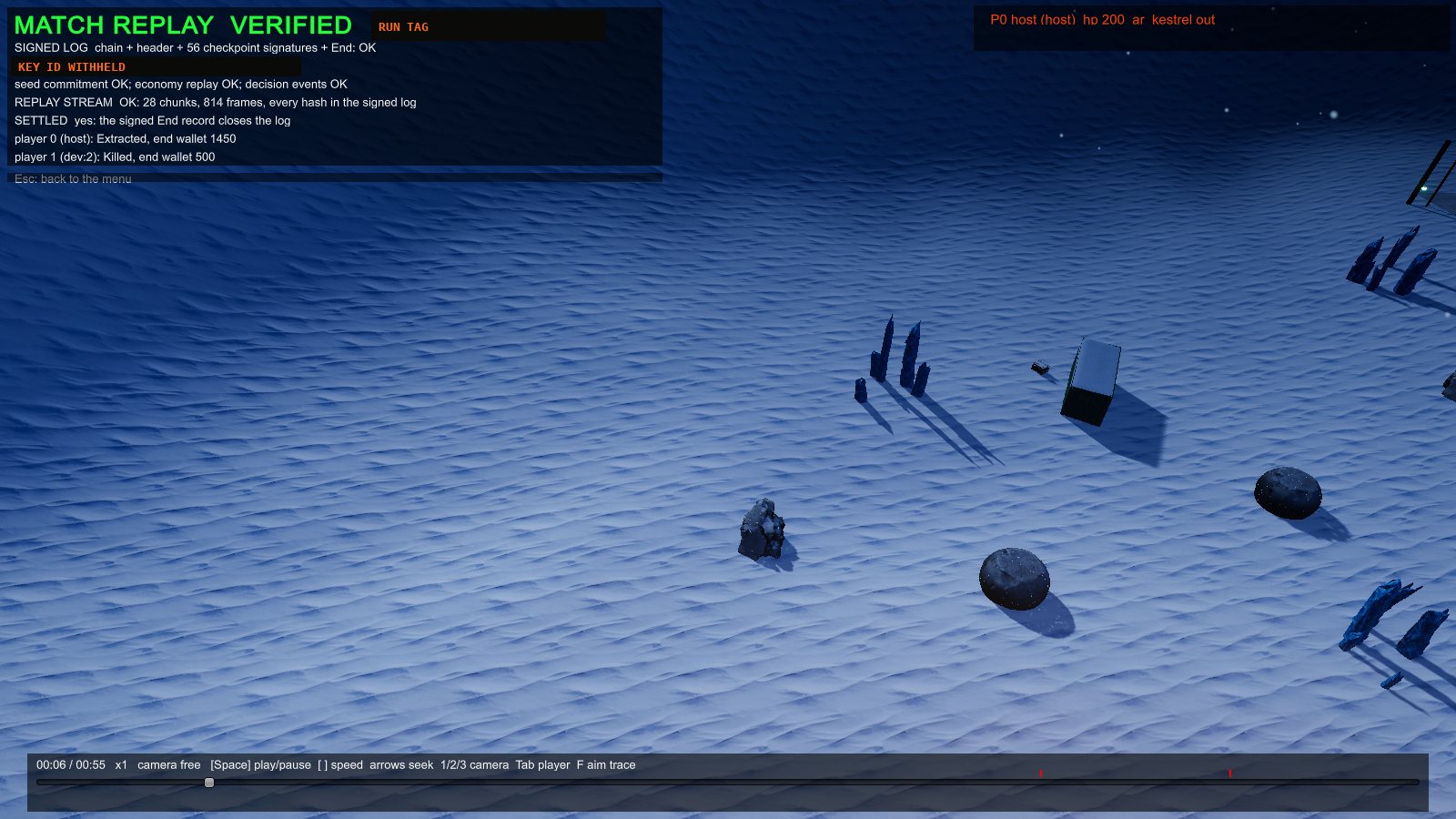
Independently checkable. Five verifiers agree to the byte.
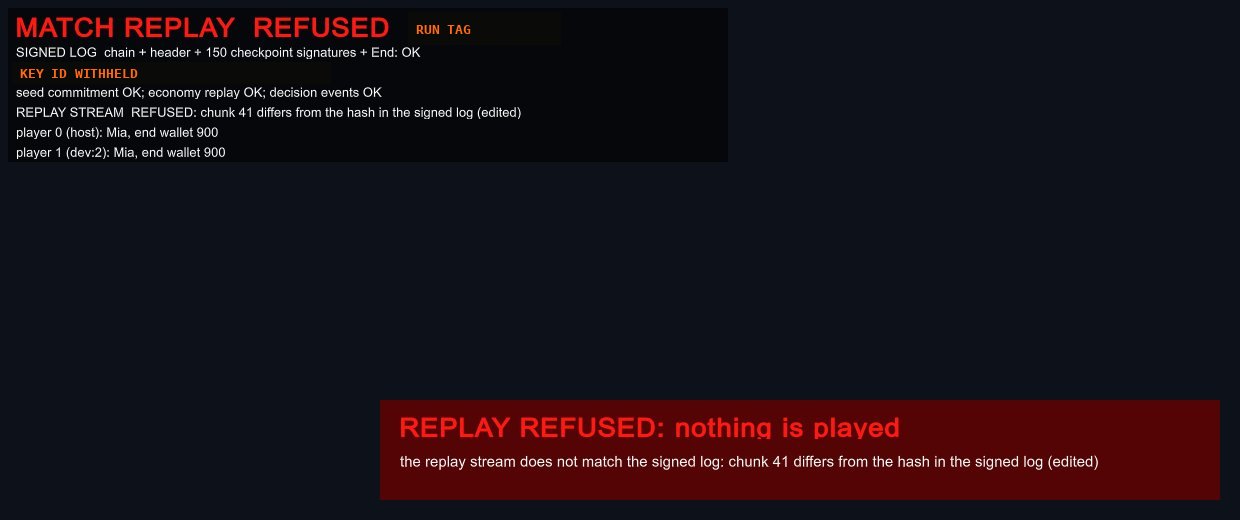
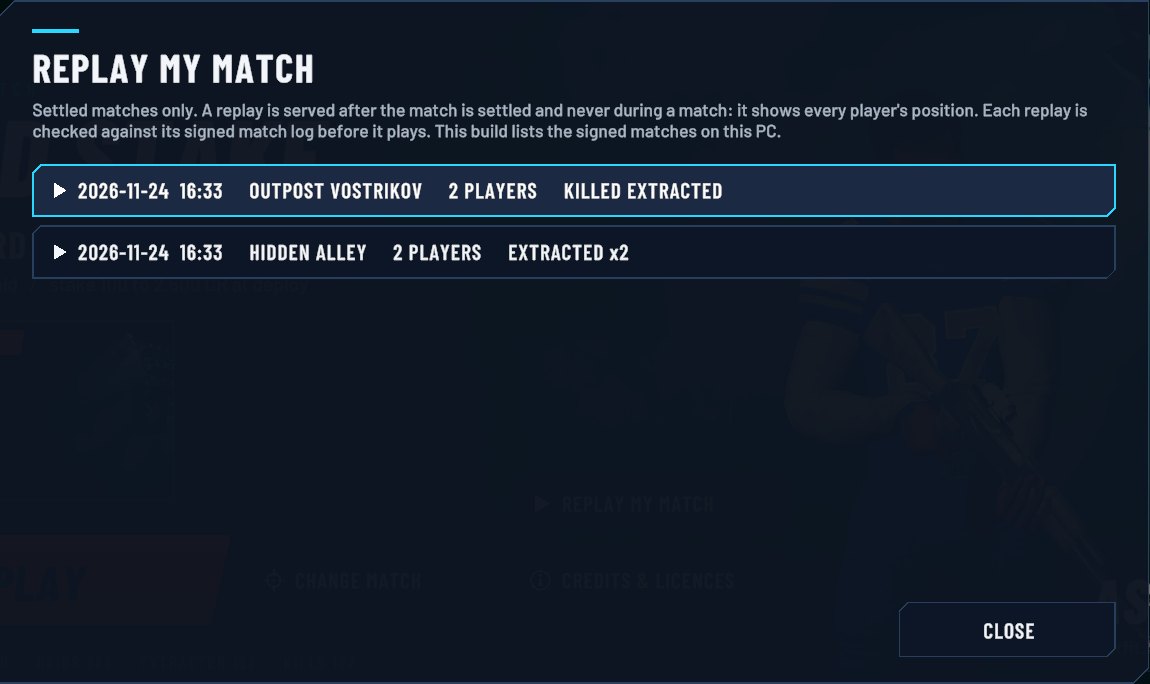
- Deterministic across machines. The same result on six runtime and CPU combinations, x86 and Arm.
- Replay streams are hashed chunk by chunk into the signed log, with 0 cm error against the server's record.
- Replays are served only after settlement, and only to that match's players.
Proof — internal red team
We attack our own game, with the real client.
A cheating build of Real Money Multiplayer plays real staked raids against real servers over the real relay, forging the game's own messages. A judge on the server rules on every attack.
Full matrix of 24 Nov 2026, targeted re-runs to 26 Nov. Later re-runs closed noclip on every tested host and flight on the dedicated server. "Player-hosted" is a test baseline; staked play runs only on dedicated servers. Movement in test runs is logged, not enforced.
Proof — every build, every night
Proven on every build. Re-proven every night.
- Integrity record matches the tracked sources
- Self-tests: signatures, log format, re-simulator, tamper cases
- Device-attestation tests on recorded real chips
- Server build, then a bot match: one honest bot, one cheating
- Log replay plus the independent verifier
- The game's own dedicated server, built from the main branch
- A staked match with two real clients: tickets, signed passes, settlement, receipt, both verifiers
On its first run, the nightly caught a main branch that didn't compile. That's the point.
Flaky failures are root-caused from saved logs and fixed in the game or the probe. No check is ever removed or loosened to get green.
Privacy by design
We collect what a check needs, and say so.
Free and practice play collect none of this. What is collected exists to decide matches fairly, and nothing else.

What we collect
- Device check (staked play only): a SHA-256 of the security chip's key (not the key), the verdict and any missing settings
- The boot log is read in memory and then discarded
- Aim in live multiplayer fights: view direction, applied recoil, aim-down-sights, shots. All of it sits inside the signed match log.
- Contributed tuning data: opt-in by every player in the match, stored separately, deleted after 180 days or on request
Never collected
- Serial numbers, MAC addresses, disk ids
- The boot log itself, file lists, running processes, memory
- Your screen
- Mouse or keyboard device data
- Hardware identifiers or IP addresses in contributed data
No kernel driver, no admin prompt. Replays go only to a match's own players. Detector reasons never reach a player.
What no software can stop alone
Some cheats look human. So we hold the money and look.
Server-side aim analysis, account history, and a human decision before any payout
Cross-match analysis on replay positions. Holds, two-reviewer confiscation, victims repaid.
Fog of war means memory holds only what you may see; aim analysis watches what you do with it
The device check requires DMA protection. Behaviour analysis covers what touches no software at all.
Roadmap
- Closed beta: the device gate is switched on for staked play, and detectors are calibrated on real, opt-in player data
- Production keys: least-privilege signing roles and compliance-mode write-once archives
- Independent review: a third-party security assessment of servers, relay, wallet and protocol
- Kernel-level partner: evaluated as an extra signal, never as the authority
- Real-money rails: identity, payments and licensing on the existing ledger (today it runs on credits)
- Open matchmaking: strangers matched onto dedicated servers
Every figure in this briefing comes from automated test matches run by our own pipeline (scripted players and attack clients), 21–26 Nov 2026. Live-player data starts at closed beta.
Real Money Multiplayer · competitive integrity
The server decides.
The record proves.
People review every flag.
x Exploitable details stay out of this briefing by design: detection thresholds, referee bounds, timing windows, keys, hosts and internal tooling. Every claim traces to the team's integrity documentation and test records.